
Experiences of broken connection, disappointment, and betrayal are something almost everyone has. For this reason, most of us struggle with intimacy.
If the old patterns have not been unlearned and new ones learned to replace them, we tend to act “economically,” that is, using minimal energy, by relying on what is old and familiar. Each person brings their own history, pain points, hopes, dreams, and typical ways of behaving into a relationship.
Especially in crises and when feeling threatened, people tend to rely on automated interaction patterns that are not always very functional—such as blaming, demanding, withdrawing, or trying to exit the relationship. The underlying aim of these patterns is to protect the person from painful emotions.
In a healthy relationship the overall atmosphere is generally safe and calm. You know that you are more than good enough in the other person’s eyes, and you think the same way about the person you are with. Neither of you feels a need to change the other, and both of you even protect one another from being pushed into your deepest pain points.
The relationship pie
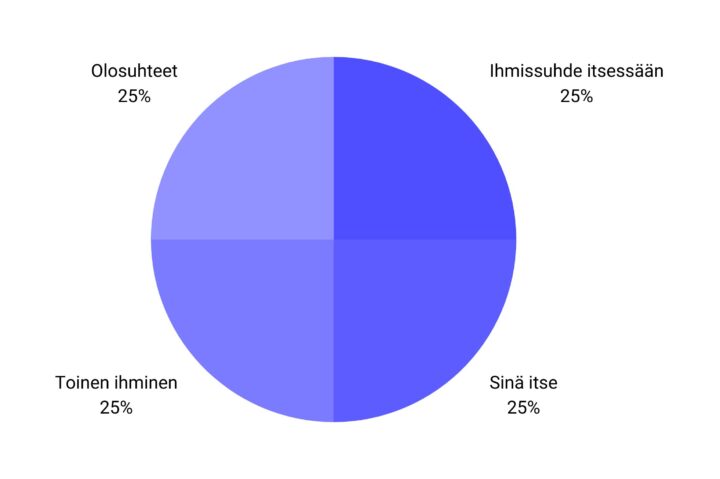
What factors influence a relationship? And who is responsible for what in a relationship? The quarter rule applies in practice to any relationship.
Imagine a pie divided into four parts (Figure 1). The size of the slices may vary depending on the situation, but the content of each slice remains the same. One slice represents the relationship itself, another represents what you bring to the relationship, a third represents what the other person brings, and the fourth represents the life situation and stage. Each of these accounts for roughly one-fourth of how smoothly the relationship functions.
Reflect, for example, on the significance of each area by considering the following questions.
- Shared lessons in the relationship: What ways of being in the relationship and interacting with each other did you set out to practice?
- What you bring to the relationship: What lessons about relationships have you gathered in your childhood and later in life?
- What the other person brings to the relationship: What skills and abilities did the other person bring into your relationship?
- Life stage: What stage of life are you currently living in?
Figure 1: The relationship pie chart
Basic interpersonal skills
Closeness is not automatically easy or only rewarding. On the contrary, it often brings out the very worst in us. It’s no wonder that many people choose to regulate their inner states by keeping their distance from relationships that become too close. And yet, connection still attracts and draws us in. This, too, is almost inevitable, because human beings are wired—right down to their nervous systems—to seek safety from other people.
“It is everyone’s responsibility to learn interpersonal skills. These skills help strengthen the foundations of human relationships: sufficient separation and a sense of connection, goodwill, and negotiation skills.”
Every relationship has its own unique dynamics and challenges. Openness, empathy, and the ability to resolve conflicts constructively are key factors that help address common sources of conflict and maintain healthy, strong relationships. It is each of our responsibility to learn relationship skills. Through them, we strengthen the fundamental pillars of relationships: sufficient individuality and a sense of connection, goodwill, and negotiation skills. Skills for constructive conflict are especially important in this regard.
Misunderstandings, disappointments, and hurt feelings are part of everyday life. Particularly difficult times are often experienced when the bliss of the honeymoon phase begins to give way to the realism of everyday life. Major changes also put relationships to the test—whether it’s a merger at work, the birth of a baby, or moving to a new place.
Working in couples or family therapy is often truly rewarding when a connection with a loved one is found. Sometimes things are so tangled that it feels difficult—even impossible—to find a way to talk about issues neutrally. In such cases, a therapist can offer a safe, neutral space for discussion, supporting constructive and secure communication from an outside perspective.
You can seek therapy for challenges in any type of relationship. Difficulties may relate to a romantic partnership, family relationships, transgenerational dynamics, friendships, or conflicts between business partners.
Save this
Tips for healthy relationships
- We humans always operate based on what we have learned in the past. If you haven’t unlearned old patterns and learned new ones in their place, you are likely to act according to what is old and familiar. What feels familiar and safe, however, is not always the most constructive option. That is why it is important to reflect from time to time on your own ways of being in relationships.
- Both you and the other person or people in the relationship bring your own histories, vulnerable spots, hopes, dreams, and typical ways of acting into the relationship. These become especially pronounced during crises, because when a person feels threatened, they tend to rely on automated interaction patterns. In such situations, you may find yourself blaming, demanding, withdrawing, or trying to leave the relationship altogether.
- It is each of our responsibility to learn relationship skills, such as constructive conflict-resolution skills. With good relationship skills, you can strengthen the foundation of your relationships: sufficient autonomy and a sense of connection, goodwill, and negotiation skills.
- Every relationship functions according to its own unique dynamics and challenges. Openness, empathy, and the ability to resolve conflicts constructively help in addressing common sources of conflict and in maintaining healthy relationships.
- You can seek therapy not only for couple or family-related challenges, but also for difficulties in other types of relationships. These may include conflicts with a friend or business partners, or other challenging situations in which you need support. You can come to sessions alone or together with all parties involved.
About the author of this article
Katri Kanninen is Doctor of Psychology, experienced psychotherapist, psychotherapy trainer (CAT), and non-fiction writer.